Enhancing Change Through Lean Methodologies
Most change programs fail not because the idea was wrong, but because the change didn't stick. Lean is, at its core, a system for making change durable.
Study after study puts the failure rate of organisational change programs somewhere around 70%. Rarely because the idea was wrong — usually because the new way of working never took hold. Six months later, the process has drifted back, the champions have moved on, and the only lasting artifact is change fatigue. Lean methodologies are, at their core, a system for making change stick.
Change with people, not to them
The Lean principle of respect for people is not a poster slogan; it’s a change-management strategy. Improvements designed with the operators who do the work start life already half-adopted: the design contains their knowledge, their constraints, their fingerprints. Change imposed from above triggers the immune system; change co-created on the gemba gets defended by the very people who would otherwise resist it.
Small steps, fast feedback
Big-bang transformations are fragile — one delay, one leadership change, one bad quarter, and the whole program stalls. Lean prefers the PDCA rhythm: small experiments, run fast, measured honestly. Each cycle either produces a confirmed gain or a cheap lesson. Momentum compounds, risk stays bounded, and the organisation learns how to change — a capability that outlives any single initiative.
Standardise the gain — the ratchet effect
Here is the step most change programs skip, and the reason they decay: standardisation. An improvement that isn’t captured as the new standard is just a good week. In Lean, every confirmed gain becomes the new baseline — documented visually, trained, audited — before the next experiment begins. Think of it as a ratchet: PDCA turns the wheel, standardised work stops it slipping back. That’s how ten small improvements become a permanently better process rather than ten fading memories.
Build the management system that carries it
Sustained change doesn’t live in enthusiasm; it lives in daily management:
- Daily huddles at a visual board — five minutes, yesterday’s abnormalities, today’s countermeasures.
- Leader standard work — managers whose calendar includes going to the gemba, asking about problems, and coaching rather than commanding.
- Escalation that works — problems a team can’t solve rise quickly to someone who can, and come back answered.
This scaffolding is what keeps improvement alive when the initial project energy fades — which it always does.
Change as a capability, not an event
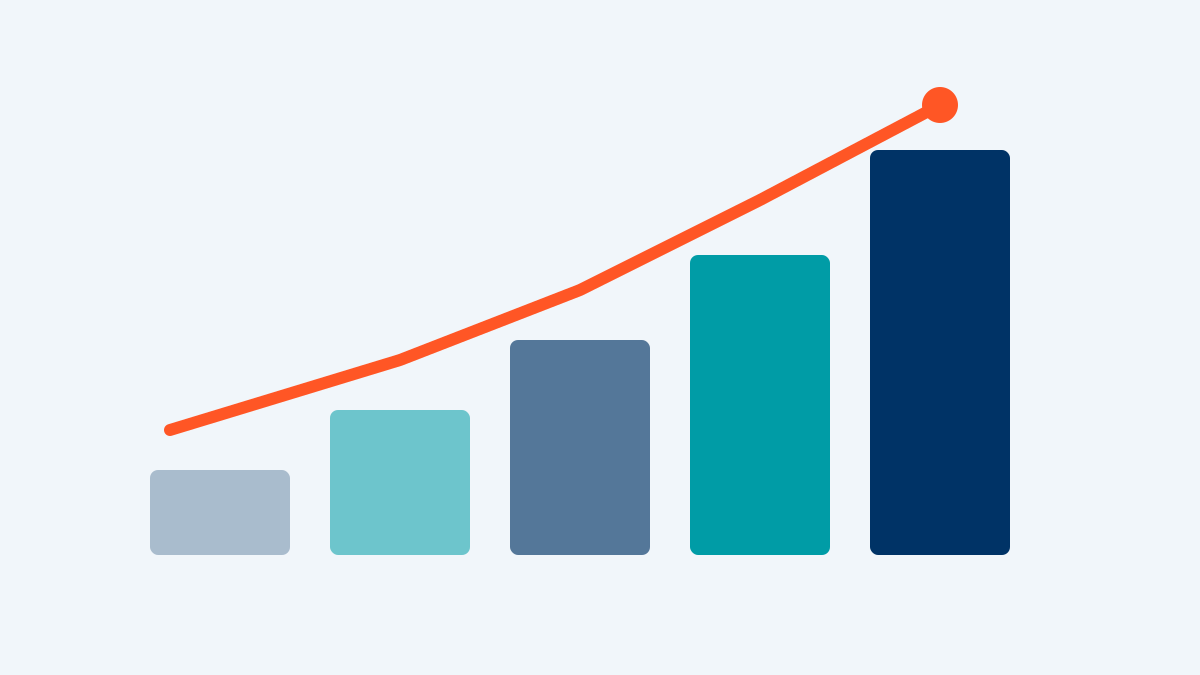
The deepest shift Lean brings is identity-level: the organisation stops treating change as a disruptive event to survive and starts treating it as what we do here, daily. At that point transformation stops needing a program at all. The people closest to the work see the next problem, run the next experiment, lock in the next standard — and the curve just keeps bending upward.
That’s the quiet power of Lean: not one dramatic change, but the permanent ability to keep changing.